


It is a well-known and widely acknowledged fact that pilots Stepan Zdorovtsev and Pyotr Kharitonov, who carried out aerial ramming attacks on June 28, 1941, survived and, ten days later, were awarded the highest Soviet decoration.
They are considered the first individuals to receive the title of Hero of the Soviet Union during the Great Patriotic War of 1941–1945. However, wartime records indicate that the feat accomplished by Red Army soldier Gurban Durdy took place a day earlier, and had it not been for routine military bureaucracy, he might have been regarded as one of the first heroes of the Great Patriotic War. By mentioning this, we do not in any way seek to revise the statistics of the war; nevertheless, facts are stubborn things. Moreover, the first person who, at four o’clock in the morning on June 22, 1941, after expending all the ammunition of his I-16 fighter aircraft, rammed a Nazi Heinkel He-111 bomber was Ivan Ivanovich Ivanov, who, like Gurban Durdy, was awarded the title of Hero of the Soviet Union posthumously much later—only in August 1941.
For us today, more than eighty years after Victory, it is not so important who was first and where while defending the Motherland. It is far more appropriate to remember and speak about the heroism, devotion, and fearlessness of all those heroes who never considered their actions to be feats. They were driven by entirely different motives and feelings: love for their homeland, the desire to protect it, their families, loved ones, and children.
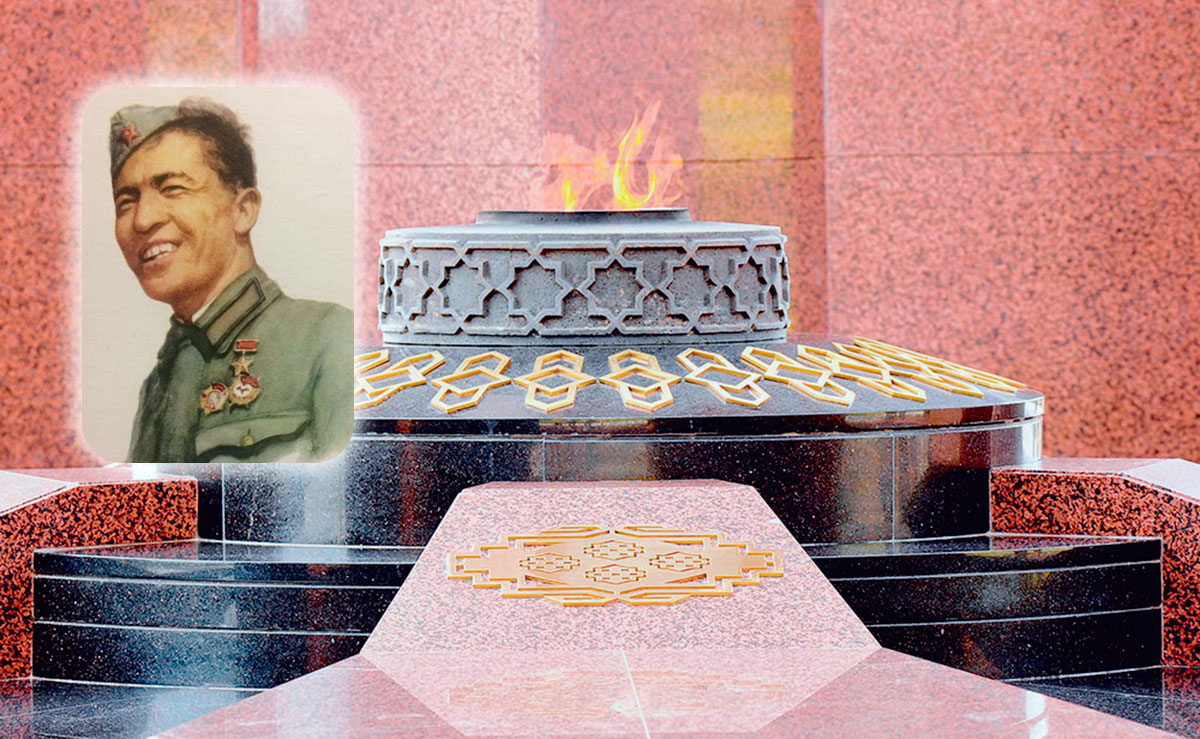
Our hero, Gurban Durdy, was no exception. He was wholeheartedly devoted to his country, loved his native land—Turkmenistan—his people, and his family. At least the older generation of our country has known about him and his feat since childhood. His portraits adorned war memorial displays, and his name was mentioned in virtually every school on May 9. A portrait of Gurban Durdy wearing the Hero’s Star decorated ceremonial grounds in summer pioneer camps. His name was easy to read and remember, although as children we were somewhat confused by the absence of a surname—both “Gurban” and “Durdy” sounded like given names. For those unfamiliar with Muslim names and the logic of Eastern surnames, it is worth explaining that Gurban is a given name derived from an Arabic word meaning “sacrifice.”
In this connection, one may recall Gurban Bayram, one of the major Islamic holidays, whose name means “the Feast of Sacrifice.” The name is widespread among many Eastern peoples, particularly among Turkic nations. Durdy is the surname, which in its Russian form would be Durdyev. It originates from an ancient Turkmen name meaning “he will live” or “live on” in Turkic languages. Such a name was often given by parents who had previously lost sons or daughters.
Gurban Durdy spent his childhood and youth in the Turkmen village of Gonur-Yab (now in the Sakarchage etrap of the Mary velayat), where he worked on a collective farm after completing six grades of schooling. Today, one can only speculate about what influenced his passionate desire to study and serve his homeland from an early age. It is also worth noting that GKurban Durdy was born during the days of the October Revolution—on October 12 (25), 1917. At the age of twenty-one, he was drafted into the Red Army. While serving, he continued his education and graduated from a regimental school, becoming an independent, confident, and well-educated serviceman. The Great Patriotic War of 1941–1945 found Gurban Durdy serving as a Junior Sergeant in northern Moldova, near the town of Edineț. His rifle regiment was among the first to come under enemy attack on June 22.
On the morning of June 22, Gurban fought his first battle and led soldiers into attack several times. Four days later, he took part in a reconnaissance mission. After crossing the Prut River, he identified the enemy’s main firing positions and assessed their strength. On their way back, the scouts encountered Romanian troops. The unit had to fight its way through, which the Red Army soldiers accomplished brilliantly, capturing several prisoners.
Later, during a fierce battle for a strategically important hill, Gurban Durdy led the soldiers in attack three times. At the height of the fighting, despite receiving a severe wound, he rose once more and led his squad forward. Inspired by their commander’s example, the soldiers broke the enemy’s resistance and held the position. For his courage, heroism, and feats performed during the crossing of the Prut River, he was awarded the high title of Hero of the Soviet Union.
After recovering in a military hospital, Gurban Durdy was demobilized in 1942 and returned to Ashgabat, where he graduated from the Pedagogical Institute in 1947. He first worked as a history teacher and later headed the Museum of History of the Academy of Sciences of Turkmenistan.
Gurban Durdy was named an Honorary Citizen of the city of Edineț and was posthumously awarded Turkmenistan’s highest distinction—the title of Hero of Turkmenistan.