


The premiere performances of “Scenes from Family Life: The Mother” at the A.S. Pushkin State Russian Drama Theatre were met with overwhelming sold-out audiences, offering spectators not merely a powerful drama but one of the season's most remarkable theatrical discoveries.
French playwright Florian Zeller is renowned for his celebrated trilogy—“The Father,” “The Mother,” and “The Son”—in which psychological theatre blurs the boundary between objective reality and subjective perception. It was the young director Andrey Pavlov who undertook the challenge of exploring the complex theme of the family as a space of love, dependence, and loneliness. Known for his distinctly cinematic style and meticulously crafted staging, Pavlov reinterprets Leo Tolstoy's famous observation about unhappy families, posing an unsettling question to the audience: Is it even possible for a family in today's world to be anything else?
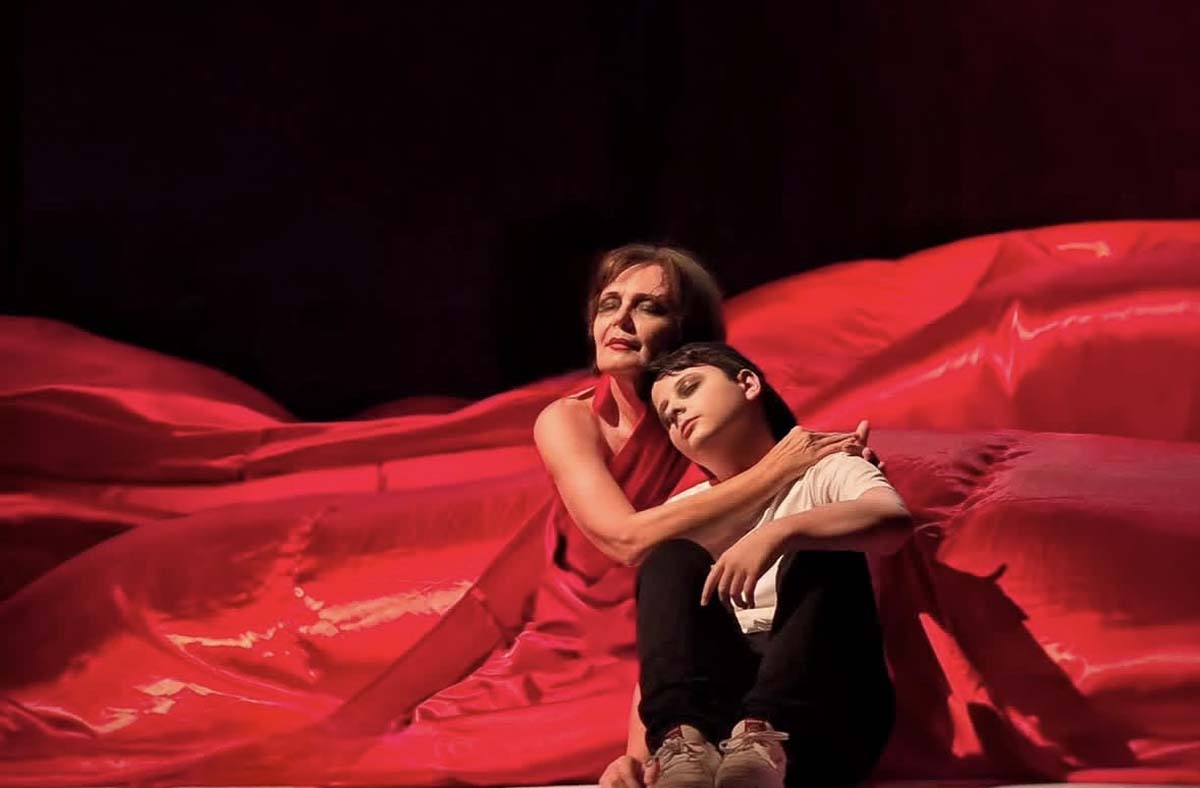
The production tells the story of how tragedy emerges almost imperceptibly—from the subtle moment when care transforms into a suffocating form of control. The audience is presented with a confined space: a square stage framed by light red fabric, within which a black leather sofa and two armchairs are tightly enclosed. This oppressive frame beneath the glowing cube of a suspended light immediately creates the feeling of a trap from which the characters cannot escape. The performance opens with an expressive, almost ritualistic dance in which the soul seems desperately to struggle against the prison of its own body, and this stifling atmosphere of emotional tension grips the audience from the very first moments.
The emotional journey is guided by the three central characters—the mother, the father, and the son. Olga Volkova, portraying the mother, does far more than simply perform the role; she gradually immerses herself in the dark emotional depths of her character until she completely dominates the stage. Her portrayal combines the frightening qualities of a giant octopus engulfing everything around it with those of a lost, childlike woman dressed in a black slip and white sneakers. Her movements are mesmerizing: one moment she leaps onto the sofa, the next she cries and screams, expressing an obsessive need to control those closest to her.
Opposite her stands her husband, played by Svyatoslav Lavin—buttoned up, almost mechanical, like a Ken doll trapped inside a business suit. Existing in a constant state of automatic self-defense, he experiences only one true emotional outburst, which erupts in a terrifying scream. Caught between them is their adult son, portrayed by Magtymguly Gurbanov, who wavers between presence and disappearance as he struggles to free himself from his mother's suffocating grip. Mirroring the adult son is his younger self—the boy he once was—represented on stage by the talented young actor Alan Apresyan.
One of the production's greatest revelations is Lyubov Yemelyanova, who plays the son's girlfriend. In stark contrast to the emotionally volatile mother, she speaks in a calm, monotonous voice, yet beneath this emotional detachment lies immense destructive power. The young actress brilliantly captures the duality of her character. Constantly shifting between different emotional masks, she paradoxically becomes the most vivid and dangerous figure on stage—a hissing, venomous cobra who gradually draws the son away from his family.
The musical score and sound design work seamlessly together, steadily intensifying the dramatic tension. At a decisive moment, the red fabric falls away, revealing a black square enclosed within another black square, creating a striking sense of exposure and uncomfortable honesty. The climax seems to begin with the appearance of a red dress. The audience senses the approach of the finale after the mother gives her son pills, telling him that this is how he must live. The production's most hauntingly beautiful image is that of waves formed by the red fabric, evoking the image of a mother's womb in which the son remains—a place from which she will never willingly release him. And if he does leave, is tragedy inevitable? We will leave the ending undisclosed for readers.
This theatrical season at the A.S. Pushkin State Russian Drama Theatre has proved exceptionally rich in premieres, demonstrating both the rapid development of theatrical art and a bold search for new artistic forms. Earlier this year, audiences warmly received Andrey Pavlov's production of “A Doll's House,” Olga Volkova's staging of “Husband for Pamela,” Bayram Garajayev's “Outrunning the Wind,” and several other productions. We wish the theatre's creative team continued artistic success and eagerly look forward to the next theatrical season, which will undoubtedly bring even more unexpected discoveries.