



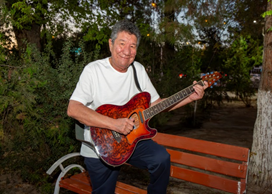
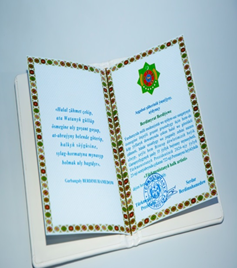
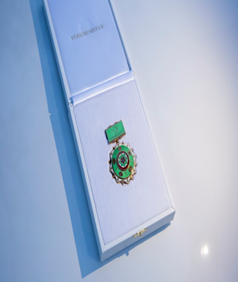

By the Decree of the President of Turkmenistan «On awarding state awards in commemoration of the 35th anniversary of independence of Turkmenistan» dated 23rd of September of this year, Ashgabat resident and singer Berdimyrat Berdiyev was awarded the title of «People's artist of Turkmenistan».
A correspondent from the online newspaper «Golden age» met with the artist and interviewed him.
– Berdimyrat, first of all, allow me to congratulate you on my behalf and on behalf of the editorial board of «Golden age» on receiving this honorary title.
– Thank you.
– Usually, journalists interviewing famous people, striving to tell readers as much as possible about their hero, begin the conversation with questions about his first steps and initial successes in his work. I would like to take you back to the atmosphere of that very significant, and perhaps even the most important competition for you – the «Golden tuning fork». Then you, a young performer little known to the Soviet audience, found yourself at the 1987 competition on the main stage of the «Olympic» Sports Complex in Moscow, where you competed with future stars - Igor Talkov and Irina Allegrova («Electroclub» Group), Alexander Ivanov («Rondo» Group), Olga Zarubina («Labyrinth» Group) and the youth ensemble «Mirage». David Tuhmanov himself is on the jury.
What was it like for a young bard from Turkmenistan to conquer the Soviet Union stage?
– In our youth, we are often driven by ambition and the desire to prove something to the world. Our university band, «Second birth», played loudly and honestly, and student construction teams adored us. On the 7th of October, 1977, the Day of the Adoption of the Constitution of the USSR, we, students, were released onto the main stage of a vast country – the Kremlin Palace of Congresses. The jitters were terrible. But it was the street training that saved me: when you are already singing in the yard in front of a tough audience, at some point the nerves pass and it becomes less scary. The audience accepts you and applauds. Something similar happened to me at the «Golden tuning fork» competition at the «Olympic» Stadium.
– So, you take the Grand Prix at the competition. As they would have said back then: «A guy from Ashgabat came and defeated the Moscow professionals». What did you feel when the results were announced?
– Probably devastation and at the same time a wild responsibility. After all, a statuette is beautiful. But when you are called «Tuning Fork», it sets the bar at its highest: from now on, you have no right to a single false note in life – neither in vocals nor on stage. You know, the «Golden tuning fork», in my opinion, is not just an award on the shelf, it is an internal censor. Today, for me, this title means only one thing: I must remain honest with my audience, no matter what I sing about – about love, about my homeland, or about the roads I have travelled.
– Berdimyrat, if you were to break down your life into chords, the first would be major and street. You have repeatedly stated before that your musical education comes from the street venues of Ashgabat. How did a guy from the Polytechnic University, playing street rock, manage to get to the Kremlin Palace of Congresses in 1977? Tell us about your origins. How did your journey begin?
– Yes, it is true! I am a «self-made man». The guitar burst into my life in my youth. Courtyards, songs with a guitar, the first chords – it was an incredible school of life, where the main teacher was the street itself, the first connoisseurs and fans were the kids from neighboring houses and streets, and the driving force was a huge desire to sing. We absorbed the music of the sixties and seventies, looking for our own style. It was there, on the streets of Ashgabat, that I realised that music is my living space.
– A little later, if my memory serves me right, after the «Golden tuning fork», your famous duet with Tazegul Velmyradova and triumph in Novosibirsk at the Viktor Khara Festival took place. They put tons of professional equipment against you, and you came out with practically just one guitar. What is this - self-confidence, insolence?
– No, of course, neither one nor the other. A simple calculation of sincerity. Tazegul sang my song «Nargul» in such a way that no speakers or amplifiers from her rivals could drown out this pure ethnic and at the same time pop wave. We took the hall with our bare hands.
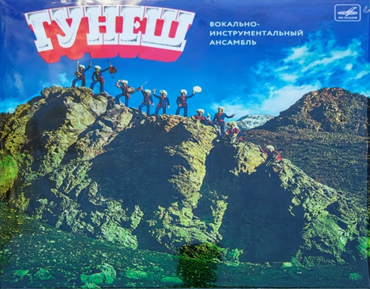
– Later, an important part of your biography became work in such iconic groups as VIA «Gunesh» and the group «Destan». What influence did this period have on your development?
– In the 1980s, the VIA «Gunesh» and «Destan» became the epicentre of the Turkmen musical explosion. These bands were decades ahead of their time, crossing jazz-rock with Eastern folklore. It was a difficult, tough, but brilliant school. In «Gunesh», for example, you could not just «go through the motions»: rhythm section of Oleg Korolev, drums of Rishad Shafi, and exactingness of Shamammet Bashimov squeezed every last drop of juice out of you. At the 1985 World Festival of Youth and Students in Moscow, with the song «Katyusha, Protect the festival», we demonstrated that Turkmen music is world-class, not just some local flavour. Besides everything else, «Gunesh» and «Destan» are an incredible forge of talent. Working in these groups taught me how to think big, be a high-level professional, and be able to hold a room full of thousands. It was a golden age for Turkmen pop music, when we experimented, sought new forms, and were not afraid to surprise.
– In the mid-1990s, you decided to leave the big stage. Why did you retreat into the shadows and how did you discover the film composer within you?
– I did not leave music; my tours continued outside of Turkmenistan. At some point, I wanted silence and solitude to reflect on the accumulated experience. I became interested in creating instrumental music and began writing soundtracks for films. Film music – an amazing thing. You have to express on a sound level what the actor plays with his eyes. It was a new side of me that allowed me to grow as a composer. I went into cinematography so as not to lose myself. Writing music for a film, for example, performing a song in the film «Nothing happened» (1989), is surgical work. You must voice the silence of the actor in the frame. This saved my internal tuning fork from rust.
– Your return to the stage at the Ashgabat «ArtIst» Theatre was called a culture shock. The concert took place on the street named after military intelligence officer Aga Berdiyev. This is not just a coincidence, is it?
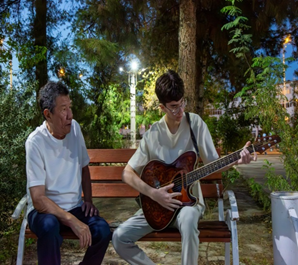
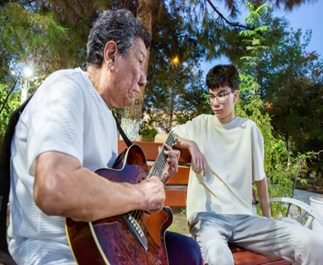
– My uncle, Hero of the Great Patriotic War Aga Berdiyev, is the backbone of our family. The fact that the theatre ended up on this street is a sign from above. My living space has become a complete circle. At that concert, my ten-year-old son Aga, named after his uncle, came out with me and sang a Beatles hit. At that moment I realised: the continuity was not broken. My audience has not forgotten me, and the new generation hears me.
– The theme of memory and continuity of generations occupies a special place in your life. At one of the concerts, the audience warmly welcomed the performance of your son, Aga Berdiyev. Tell us about the meaning of this name for your family.
– I have already noted that my son is named after my uncle, a military intelligence officer and Hero of the Great Patriotic War, Aga Berdiyev. A cozy street in Ashgabat is also named after him, where the «ArtIst» theatre, where we gave our concerts after a long break, is symbolically located. Once upon a time, as a child, I started my journey on this street, learned to play the guitar, tried to sing, including hits of The Beatles. And the fact that my son once went on stage and sang one of the pieces of the Liverpool Four is a great joy for me. Music continues in children, traditions live on.
– Berdimyrat, your concerts are always an incredible mix: from soulful bard songs like «And I am going behind the fog» to iconic Soviet romances and rock. How do you manage to stay relevant to both your peers and young people?
– There is no secret here – a good song has no age. When I perform «I will never forget you» from the rock opera «Juno and Avos», the audience sings in chorus. Young people feel sincerity. If you go on stage with an open heart, without trying to be someone else, the audience will pick up on it instantly. Music is the language of emotions, and emotions are universal at all times.
– When you sing «I will never forget you» from «Juno and Avos» as an encore, both thirty-year-olds and those over sixty cry. What is the magic?
– The magic is that I do not try to look young or flirt. I am going out with my old friend the guitar. A song is not a fashion, it is a heart-to-heart conversation. If you believe in what you sing about, the audience will transmit your energy back.
– Berdimyrat, if you had the opportunity to change just one note in your life, what would it be?
- None. Even the most tragic or difficult chords of my destiny were necessary so that today I could tune my voice to a pure, golden sound. Life is lived without falsehood – and this is the most important thing for a musician. And I am immensely grateful to the President of Turkmenistan for appreciating my modest contribution to musical heritage of the country, as well as to everyone involved who appreciates my work.
– What would you wish for young people who are just starting to pick up a guitar and perhaps dream of following in your footsteps?
– I would wish them to love art in themselves, and not themselves in art. Do not chase cheap popularity. Find your own pure sound. Be true to your dream, work hard and remember that your main judge is your own conscience and your inner tuning fork.
From the editors: There is no doubt that for young musicians today, the life and career of People's artist of Turkmenistan Berdimyrat Berdiyev serves as a benchmark for high art and an example of the importance of remaining true to one's calling.