


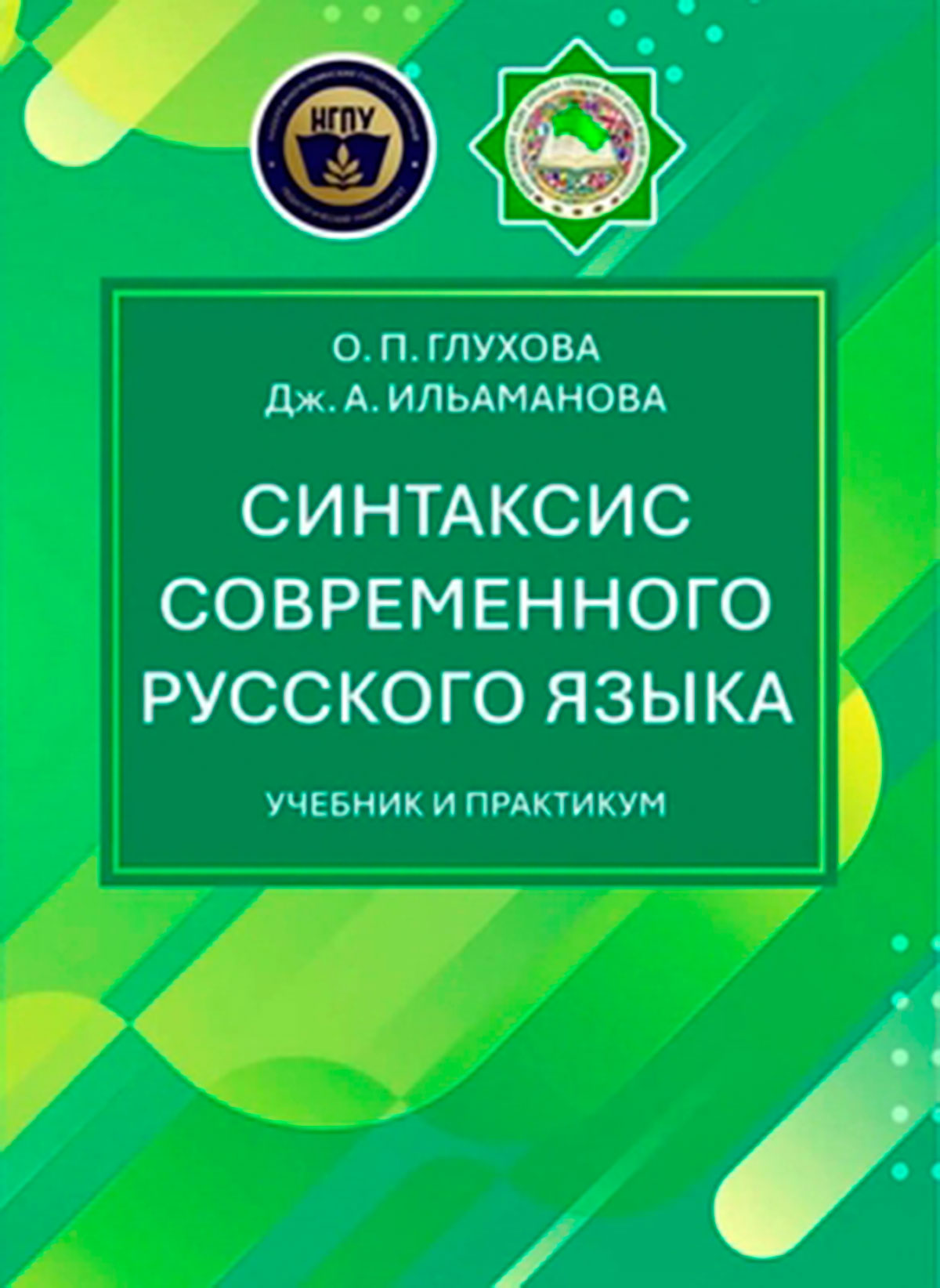
The Kartush Publishing House, located in the city of Oryol of the Russian Federation, has released a new textbook and practical course for universities, "Syntax of the Modern Russian Language."
The new publication has been prepared in co-authorship by teachers of the Faculty of Russian Language and Literature of the Dovletmammet Azadi Turkmen National Institute of World Languages and the Department of Russian and Tatar Philology of the Faculty of History and Philology of the Naberezhnye Chelny State Pedagogical University (Russian Federation). The authors of the textbook are O. Glukhova and J. Ilamanova.
This publication has become another productive result of the joint work of Turkmen and Russian specialists, carried out within the framework of the Memorandum of Cooperation between the D. Azadi TNIWL and the NSPU (RF). The preparation of joint textbooks is also defined by the Program of Intensification (roadmap) of cooperation between the two universities for 2026.
The book is an educational and methodological complex that includes theoretical and practical material necessary for mastering the course of syntax of the modern Russian language. It consistently examines the main syntactic units of the Russian language – from the phrase to the complex syntactic whole, taking into account classical and modern grammatical theories. At the end of each chapter there is a block of exercises for practicing and consolidating knowledge. They can be used both within the framework of classroom work with a teacher and as independent work of the student.
A feature of the textbook is the culturological principle of selecting material for the analysis of various syntactic phenomena. The tasks include not only examples from Russian classical literature (A. Pushkin, M. Lermontov, I. Turgenev, L. Tolstoy, A. Chekhov, A. Kuprin, etc.), but also from works of Turkmen authors translated into Russian (A. Kaushutov, O. Akmammedov, A. Durdyyev, H. Deryayev, S. Annasahatov, etc.), as well as classics of Eastern literature (Saadi, Nasir Khusraw, Sanai, Ibn Namin, etc.). Such a selection of texts makes learning personally oriented and fosters in students a careful attitude toward the cultural heritage of different peoples.
The textbook is intended for philology students, master's students, postgraduate students, Russian language teachers, as well as all readers interested in the study and teaching of the Russian language. It will help systematize knowledge of syntax and practice the skills of syntactic analysis of text, and will also serve as a valuable methodological source.
The publication of the joint book has become another confirmation of the fruitful and active interaction between the Turkmen and Russian universities, as well as the building up and progressive development of mutually beneficial scientific and educational cooperation between the two friendly countries.