


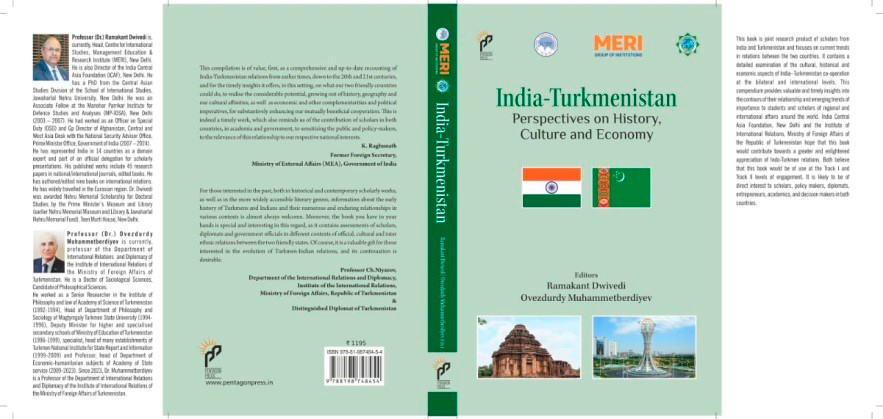
The compilation titled "India-Turkmenistan: Prespectives on History, Culture and Economy" was published in English by the Indian publishing house Pentagon Press LLP. The book was published with the active participation of the faculty members of the Institute of International Relations of the Ministry of Foreign Affairs of Turkmenistan.
The editorial team of "Golden Age" addressed several questions to one of the editors of the collection, Professor of the Department of International Relations and Diplomacy of the Institute, Doctor of Sociological Sciences Ovezdurdy Berdiyevich Muhammetberdiyev.
- Dear Ovezdurdy Berdiyevich, to begin with, could you tell us how the idea to publish a joint Turkmen-Indian popular science work was born?
- When we began preparing the compilation, we decided to move away from the somewhat formulaic approach of presenting materials as ordinary scientific reports. It seemed to us that the best result of our many years of Turkmen-Indian scientific partnership would not be just a collection of materials but a serious, fundamental scientific-historical work that would serve as a solid foundation for future research and strengthen mutual understanding not only between the scientists of Turkmenistan and India but also between our peoples.
The new book is the quintessence, one of the serious results of the multifaceted cooperation between the Institute of International Relations of the Ministry of Foreign Affairs of Turkmenistan and a number of higher educational institutions and research centers from various countries around the world. It was prepared within the framework of ongoing collaboration between the Institute of International Relations and the Indian Center for International Studies MERI, the India – Central Asia Foundation. According to the agreement, the book was prepared as a compilation of scientific articles by Indian and Turkmen authors on topics related to the history, present and future of India-Turkmen relations.
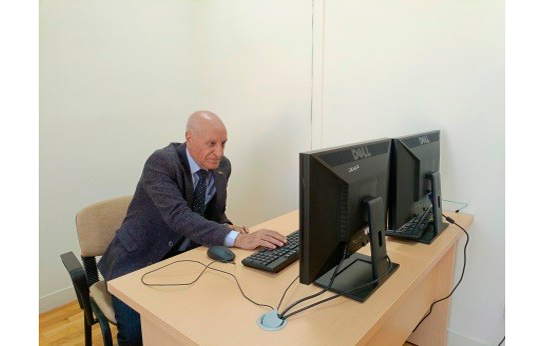
- Our readers would be interested to know about the authors of the materials and articles included in the compilation. It seems this would attract the attention of specialists and simply readers of popular science literature to the new book.
- I am sure that is what will happen. The authors whose thoughts, opinions, and reflections are published in the collection are authoritative and experienced diplomats. This is, as they say today, the highlight, the special feature of the publication. The selection of authors was very careful: we tried to present different points of view and scientific schools so that the book would have not only academic but also practical value. Leading international scholars, historians, sociologists, civil servants, and, especially valuably, authors of some of the articles included are distinguished veterans of diplomatic service from both India and Turkmenistan.
Announcing the content and authors of the collection, I would like, first of all, to mention some names representing Turkmenistan: Ambassador Extraordinary and Plenipotentiary of Turkmenistan, Hero of Turkmenistan Chinar Rustemova; Ambassador Extraordinary and Plenipotentiary of Turkmenistan, Doctor of Historical Sciences, Professor Amangeldi Rahmanov; Ambassadors Extraordinary and Plenipotentiary – Sapar Berdiniyazov and Nurberdi Amanmyradov. These are those who stood at the origins of independence and neutrality of our Homeland, those who know firsthand how our relations developed at various stages of history. Their personal impressions and analytical assessments are invaluable material for future generations. The very fact that the authors of the articles are primarily well-known scholars and distinguished diplomats gives us confidence that the information they present, the conclusions they draw on various issues of Turkmen-Indian relations, and the proposals and views they put forward will be of great interest to the readers of the book.
- Ovezdurdy Berdiyevich, the title of the book says it all: it covers the past, present and future of relations between our countries. Could you outline the main idea that forms the basis of the book?
- Regarding the history of Turkmen-Indian relations, the key idea laid down in the compilation is that our relations and ties between peoples go deep into the centuries, to the Great Silk Road era. These are not relations of recent decades but a centuries-old tradition of mutual interest, trade, and cultural exchange. As for our current relations, the authors of the book focused on the dynamic development of political dialogue, trade and economic cooperation, particularly in the energy sector (for example, the implementation of such a major project as TAPI), and cultural-humanitarian ties.
The articles in the collection particularly emphasize the personal contribution of the President of Turkmenistan Serdar Berdimuhamedov and the National Leader of the Turkmen people, Chairman of the Halk Maslahaty of Turkmenistan Gurbanguly Berdimuhamedov, to the development of the strategic character of Turkmen-Indian relations. As for prospects, the authors unanimously agree that there is enormous potential for growth in these relations. They outline ways for expanding cooperation in digital technologies, artificial intelligence, cultural exchange, education, healthcare, tourism, sports, and security, particularly cybersecurity. The book proposes ideas for filling the format of our strategic partnership with new content.
- The book was published in India in English. Is there a plan for an edition designed for the Turkmenistan reader?
- This is an important step for us. The English edition is mainly oriented towards an international audience, the global academic community, and particularly the Indian audience, for whom English is one of the main languages alongside Hindi. The Turkmen edition, which we are working on today, will be intended for our broad public: students, historians, political scientists, international relations scholars, future diplomats, and all citizens of Turkmenistan interested in foreign policy. This will make it possible to convey the rich content of the book to our audience in their native language, significantly enhancing its educational effect.
- The collection is one of the first results of cooperation between your institute and Indian colleagues. What are the next steps in this direction?
- We consider this book a first sign. We have big plans. These include holding joint international conferences, round tables, and possibly launching exchange programs for students and professors. I am confident that the successful joint experience of working on the collection will open a new stage in academic cooperation between our countries. The collection itself is a kind of new reliable bridge on this path: it shows that the mutual desire to deepen cooperation between countries exists not only at the level of diplomacy and economy but also in scientific, educational and cultural fields.
- What would you personally call the main outcome of working on this project as a co-editor of the book?
- The main outcome is, of course, the awareness of how strong and multifaceted the foundation of our scientific relations is. Working on the book in close contact with Indian colleagues once again showed that we have a common vision of the future and a sincere desire to work together for the prosperity of our peoples. Our book is not just a compilation of articles; it is a bridge of friendship and mutual understanding built through the efforts of authors from our two friendly countries.
- Thank you very much for your answers. We wish you and the entire scientific staff of the university new successes.
- Thank you too! I am confident that this edition will become a desk book for all who study and develop relations between Turkmenistan and the Republic of India.