


The Turkmen State Publishing Service, upon the recommendation of the Ministry of Education of Turkmenistan, has released new textbooks for the country’s general secondary schools.
A new Japanese Language textbook for 5th-grade students has recently been published. It was prepared in accordance with the approved curriculum, taking into account modern requirements for improving foreign language teaching methods. The authors of the textbook are N. Amangeldiyeva, Z. Khodzhagurbanova, and T. Uehara.

The textbook covers topics such as an introduction to Japanese writing, basic forms of greetings, and sections titled “Introducing Myself,” “My Family,” “My School,” “School Supplies,” and “My Classroom.” It includes texts and exercises for reviewing material, audio supplements for developing listening skills, and a bilingual glossary to help students acquire new vocabulary.
All materials in the new textbook are designed to significantly enhance students’ reading, speaking, and writing skills, as well as enrich their vocabulary.
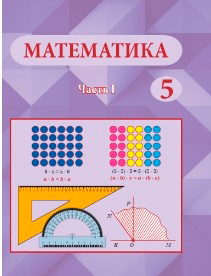
For 5th-grade students studying in Russian-language schools, the second, revised and expanded edition of the textbook “Mathematics. Part 1” has recently been published. The authors are Zh. Starostina, S. Volkova, and Kh. Geldyev.
The textbook consists of two main sections: “Natural Numbers and Operations with Them” and “Geometric Figures and Measurements.”
The first section covers the concepts of natural numbers and zero, rules for writing and comparing numbers, operations of addition, subtraction, multiplication, and division, their properties and interrelations. Special attention is given to the study of equations, algebraic expressions, and the distributive property of multiplication.
The second section introduces students to basic geometric concepts such as line segments, angles, triangles, squares, rectangles, and cubes. It also covers methods of measuring length, area, volume, and mass, and develops construction skills using a ruler and protractor. The textbook includes tests and self-assessment exercises to encourage learning interest and independent study among students.
The publication has been prepared in accordance with modern educational standards, considering students’ age-specific characteristics, and aims to develop a solid foundation in mathematics, enhance logical and spatial thinking, and foster the ability to apply acquired knowledge in practice.
For 2nd-grade students studying in Russian-language schools, the textbook “Fundamentals of Informatics” has been republished. Its authors are L. Ruliyeva, V. Chernikova, J. Annamuradova, O. Mammetkulieva, and Kh. Bayramova.
This textbook includes seven thematic sections that sequentially introduce the main topics of the subject. It begins with safety rules when working with computers and the basics of input and output devices. Students then learn about various types of information — graphical, textual, sound, and symbolic. Special attention is paid to developing algorithmic thinking through studying different ways of recording algorithms and their performers.
The practical section focuses on mastering the Windows environment, working with the keyboard, and the basics of computer graphics, including image editing and fragment manipulation. The materials conclude with an introduction to basic Internet concepts. Each section includes practical exercises and review questions.
The new textbook is expected to improve the quality and effectiveness of digital literacy education for 2nd-grade students and provide a solid foundation for their further in-depth study of informatics.