






In 1879, Norwegian writer and playwright Henrik Ibsen based his play «A Doll's house» on a true story. At the time, Norwegian society saw feminist undertones in the play and vehemently justified forgery of the Nora, citing a noble motive—a crime committed to save a loved one. Today, this view can be challenged, but that is not the point.

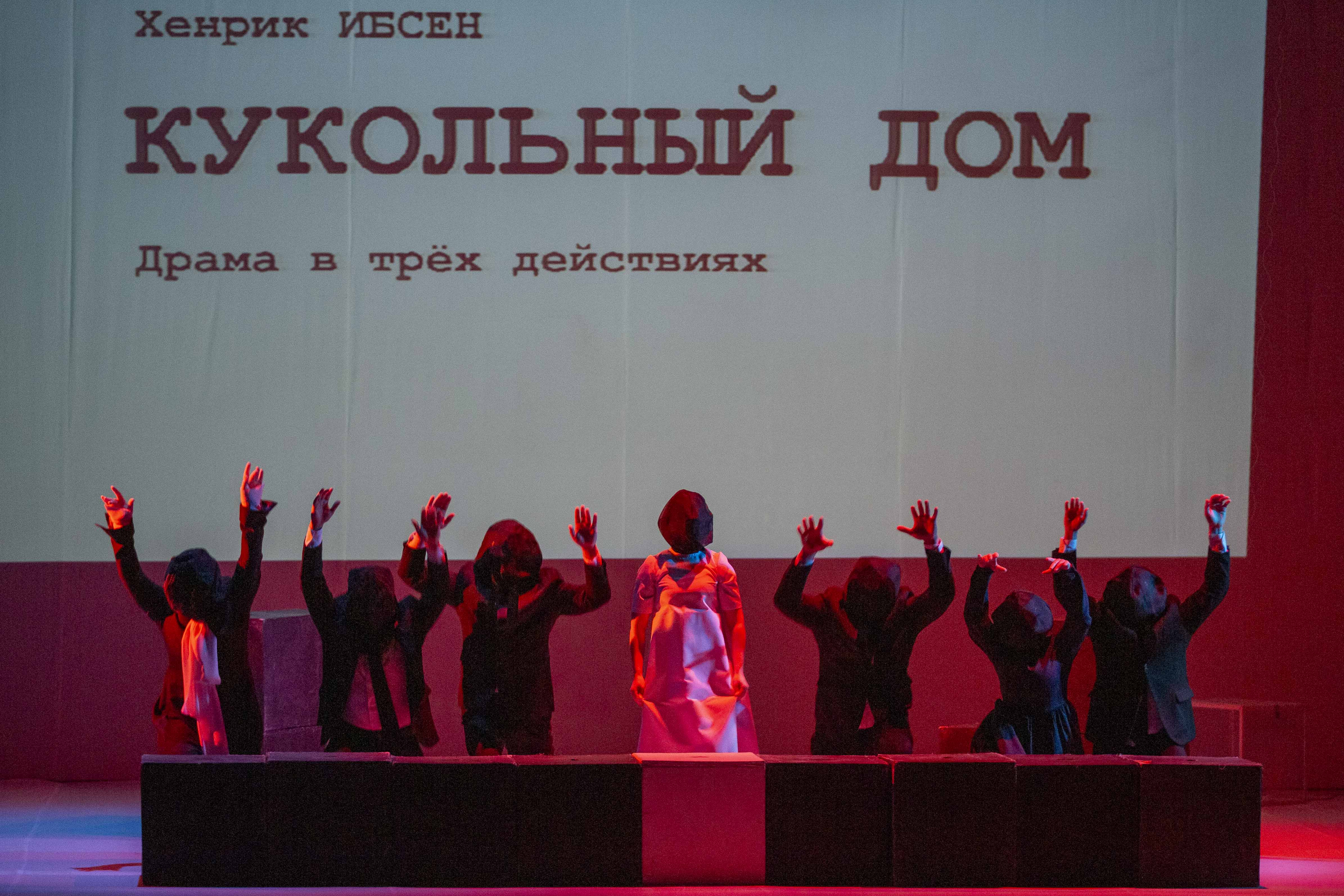
«A Doll's house» received an eccentric performance at the State Russian drama theatre named after A.S. Pushkin. Director Andrey Pavlov presented it to audiences in black and white, with each character performed by two actors. The face of second actor was covered. This emphasised the duplicity of all the characters, which became the norm at the Doll's house. An interesting detail was the unusual decoration of the faces of characters with glitter, which also demonstrates the desire of everyone in the Doll's house to appear better than they actually are.

The owners of the Doll's house, the lawyer Helmer and his wife Nora were thrilled to hear the news: Helmer had taken over as bank manager. But among his papers, Helmer found a letter from Krokstad, revealing a promissory note forged by Nora. Helmer was furious: his entire successful career was in tatters. He was ready to tear Nora to shreds, but after a while, he read a second letter from Krokstad, in which he promised not to reveal this secret. The expression of Helmer changed, and he once again considered Nora the most wonderful woman in the world.

In other words, crime of Nora only troubles Helmer as a shadow cast on his reputation. Consequently, Helmer, seemingly the most upstanding man in the Doll’s house, turns out to be less than serene. And Nora becomes disillusioned with her husband. She breaks off all ties with him and leaves the Doll’s house.

– It should be noted that presenting the play for the celebration of Neutrality was very appropriate, – says director Andrey Pavlov. – We tried to understand, rather than condemn, the characters in the Doll’s house.

A unique addition to the performance was the projection of paintings by contemporary artists of the time onto the walls of the Doll’s house auditorium: Vasiliy Kandinskiy's «Winter Landscape», Gustav Klimt's «Girlfriends», Pablo Picasso's «Girl on a Ball», Kazimir Malevich's «Black Square», and others. While the paintings adorned the interior of the Doll’s house auditorium, they also revealed the subtext of the events unfolding on stage. Moreover, such an illustration of the play testified to the refined taste of its creators.

For actors Anna Hommadova and Magtymguly Gurbanov, their performances as Nora and Helmer were a great creative success, and it should be noted that they flawlessly conveyed the psychological drama of their characters.


