


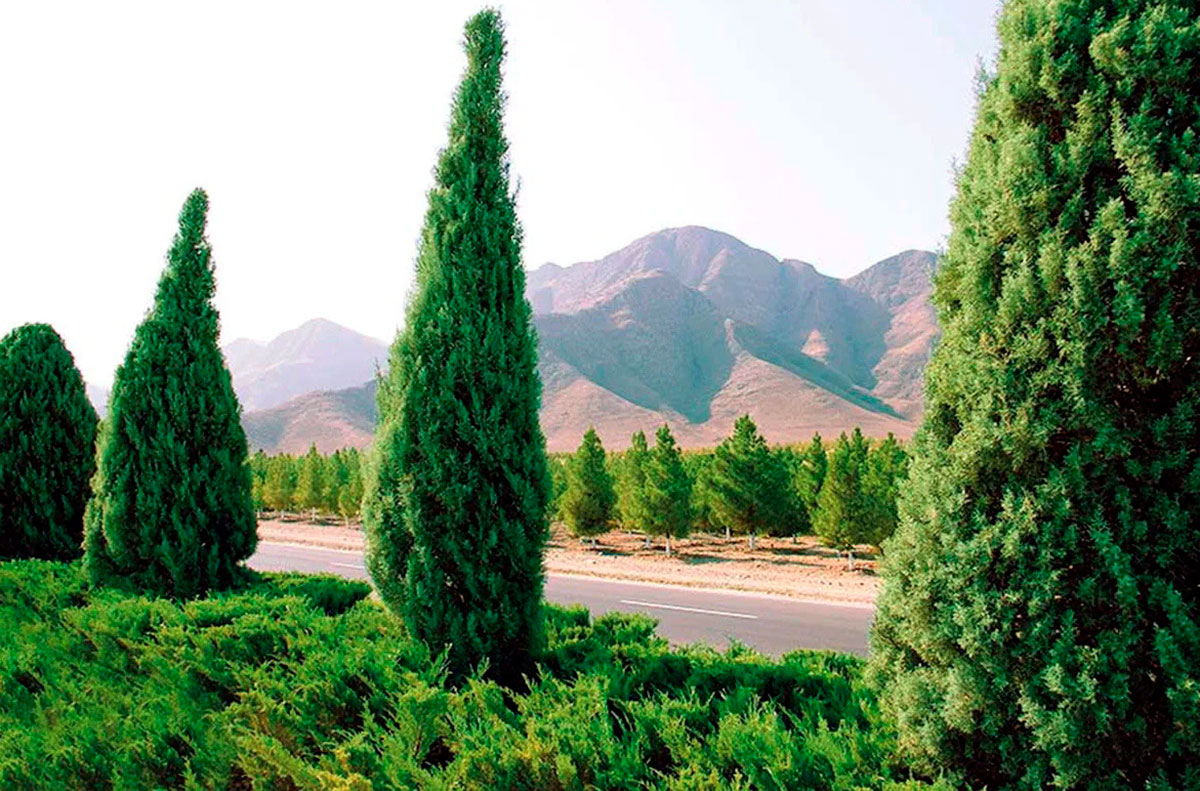
Thanks to consistently carried out landscaping activities, including the annual nationwide tree planting campaign, the green ensemble of Dashoguz is becoming more and more beautiful. Today, the streets, parks and squares of the city are decorated with various types of coniferous, deciduous trees and shrubs, including several varieties of thuja and ash, gujum, poplar, mulberry, horizontal juniper, and decorative barberry. It should be noted that an increasingly large part of the garden and park ensemble of the city is occupied by coniferous trees and various types of thuja.
Among local gardeners and landscape designers, due to their unpretentiousness, such types of thuja as Thuja orientalis, known among gardeners as oriental thuja, as well as Oriental biota, which can grow on saline soils, are popular.
Thujas not only take root well in local soil and climatic conditions, but also grow quickly. At the same time, they are now increasingly decorating private courtyards. They attract the local population not only with their beautiful appearance, but also with their beneficial properties. Thuja has a high content of phytoncides, and all its species have them. They release oxygen throughout the year and clean the air of dust. Thujas are well suited for shaping, form hedges, and are actively used in landscape design, including in group plantings. An important role is also played by the fact that thujas are unpretentious in planting and care, are durable and resistant to pests. It is believed that they can transform any landscape.
Today, thujas decorate the dividing strips of central highways of the city and create a «green belt» between oncoming traffic flows. Here they perform not only an aesthetic function, but also protect drivers from being blinded by the headlights of oncoming cars and prevent gas pollution on the streets. The consistent replenishment of the garden and park ensemble of Dashoguz with thujas is also facilitated by the fact that every autumn the seeds of these evergreen perennials are collected by specialised institutions, from which seedlings that are resistant to the local climate are then grown in nurseries.