


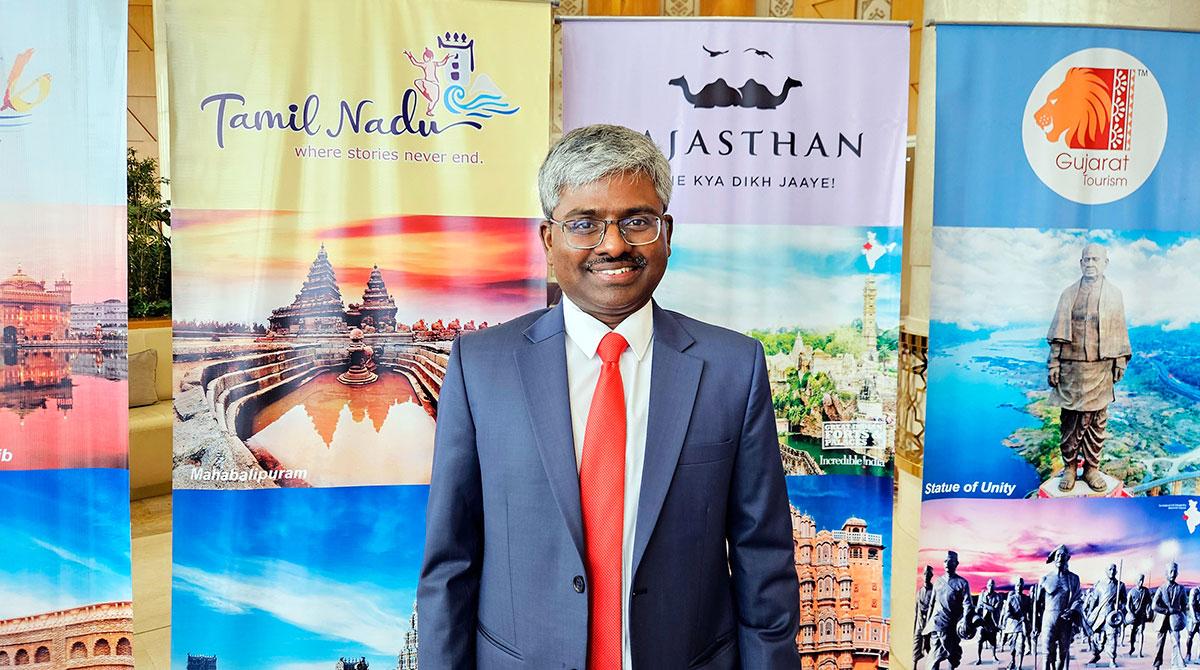
Relations between nations are often measured not only by recent decades but also by centuries of shared cultural heritage. In response to a question from a correspondent of “GA,” the Ambassador of India to Turkmenistan, Bandaru Wilsonbabu, shared his vision of contemporary ties between New Delhi and Ashgabat, emphasizing that the foundation of relations between the two sovereign states lies in the dialogue of two of the world’s greatest ancient civilizations.
The head of the diplomatic mission noted that although India and Turkmenistan, in their modern statehood, are relatively young countries (having gained independence in 1947 and 1991, respectively), their spiritual kinship goes back deep into history.
“India is a civilization more than 5,000 years old, just like Turkmenistan. There is evidence that active trade and cultural interaction existed between the peoples of the Indus Valley and ancient Turkmenistan as far back as five millennia ago,” said the Ambassador.
Today, India is represented in Turkmenistan not only through its diplomatic presence but also through a strong public interest in its rich heritage. Films, music, yoga, and Ayurveda have become an integral part of Turkmenistan’s cultural landscape, the diplomat noted.
In this regard, institutional support for this interest was also highlighted. A Center for Yoga and Traditional Medicine is successfully operating under the Ashgabat city khakimlik. In January of this year, a Hindi Corner was ceremonially opened at the D. Azadi Turkmen National Institute of World Languages. A specialized Ayurveda classroom has begun operating at the M. Garryev Turkmen State Medical University.
“The embassy’s plans for the coming year include inviting leading specialists from India to teach Hindi and the fundamentals of traditional medicine, which will help bring cooperation to an academic level,” stated Bandaru Wilsonbabu.
Particular attention was also given to humanitarian exchange. India actively cooperates with Turkmenistan in developing human capital. Each year, hundreds of Turkmen students choose Indian universities for higher education, which confirms the prestige of India’s education system.
The Ambassador also emphasized India’s readiness to expand educational programs, adapting them to the specific needs of Turkmenistan’s economy. This includes developing specialized courses for civil servants in strategically important sectors such as oil and gas, the chemical industry, pharmaceuticals and healthcare, digital technologies, and education.
Bandaru Wilsonbabu expressed deep gratitude to President Serdar Berdimuhamedov and the National Leader of the Turkmen people, Chairman of the Halk Maslahaty of Turkmenistan Gurbanguly Berdimuhamedov, for their support of Indian initiatives and their significant contribution to the development of bilateral relations.
“India regards Turkmenistan as a very close partner and reaffirms its commitment to further strengthening ties between our two countries, whose friendship, rooted in the depths of millennia, is today acquiring new meaning,” concluded the head of the diplomatic mission.