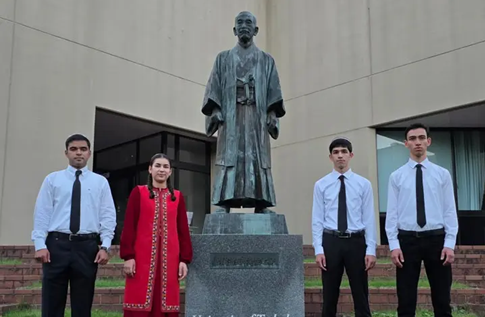



Not long ago, the State Energy Institute of Turkmenistan hosted an online competition among university students titled “World Languages – Paths of Friendship” in the discipline “Professional Russian.” Organizers, specialists, and educators working with school and university students across the country noted the participants’ high level of preparation and their strong interest in studying the Russian language and applying it in professional fields. They also emphasized the importance of such events as one of the most effective means of promoting the Russian language and literature among young people. Further evidence of the growing interest in learning Russian was the participation of more than 80 contestants from 17 higher educational institutions of the country.
It should be noted that Russian language competitions, regularly held in Turkmenistan, contribute to increasing interest in language learning, developing linguistic skills, and, of course, strengthening cultural and educational ties. These competitions are aimed at improving spoken language abilities, critical thinking, and the creative talents of participants. Talent and essay contests are often conducted under the slogans “Turkmenistan – Homeland of Peace and Trust” or “Russian as a Means of International Communication.” Such events attract an ever-growing number of participants, especially among senior school students, which also reflects the increasing interest in learning the language.
Our students actively participate in prestigious international intellectual competitions such as “Yarus” and “Homo Dicens,” where they win prize places. For example, this year, Medine Sopytaganova, a student of Turkmen State University, became the winner of the International Russian Language Olympiad. The prestigious competition was organized by Moscow City University together with the Institute of Humanities of the Russian Federation. This year, around 200 students from Russia, China, Saudi Arabia, Jordan, Serbia, Moldova, Kazakhstan, Kyrgyzstan, Uzbekistan, and Turkmenistan took part in the Olympiad. The student’s success was not accidental: Medine has repeatedly won awards in various national and international intellectual competitions.
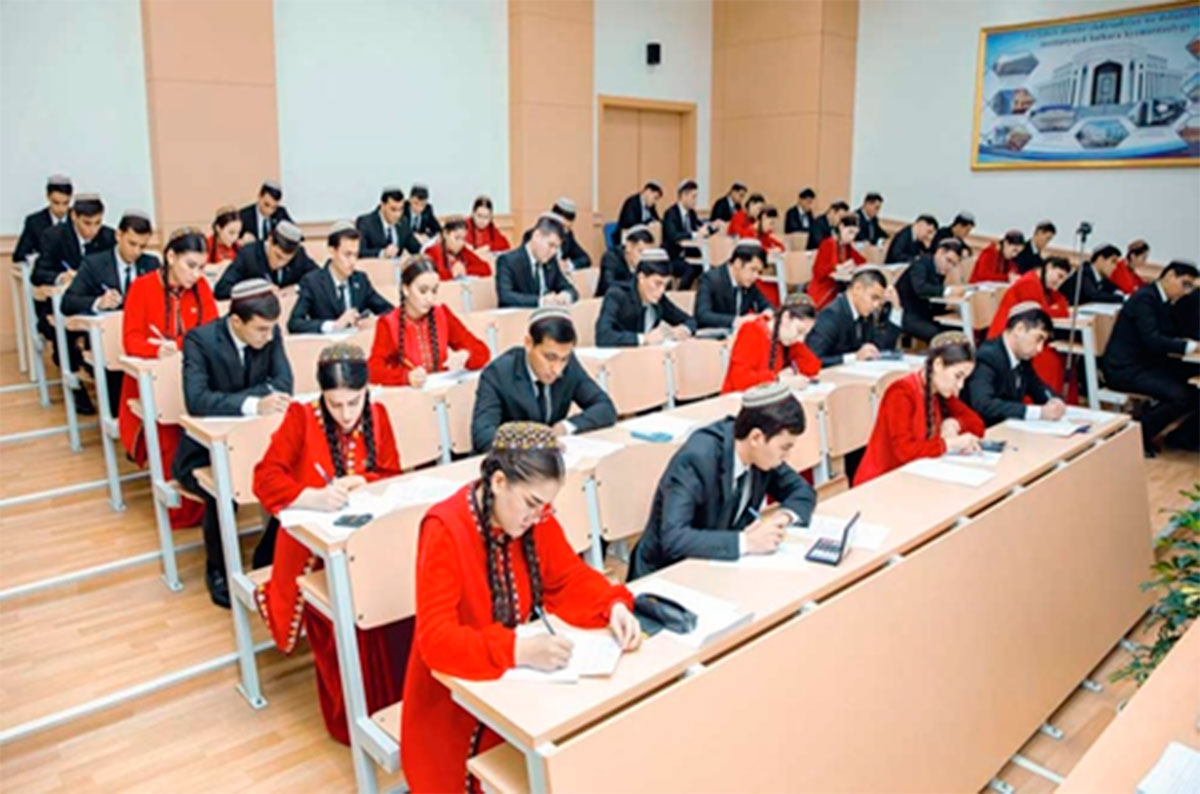
An international Russian language competition among students from Turkmenistan and the CIS countries was also organized by the Institute of International Relations under the Ministry of Foreign Affairs of Turkmenistan. The competition, titled “Russian – the Language of Interethnic Communication and Diplomacy,” was aimed at increasing student interest in studying Russian as a language of interethnic communication and one of the official languages of the United Nations.
Russian language competitions for foreigners are also held within the framework of the “World Championship.” This is a large-scale international event for everyone who loves and studies the Russian language. Participants are offered an engaging format for testing their knowledge, including team-based interactive tasks, quizzes, debates, and quests, where it is important not only to demonstrate proficiency in Russian but also teamwork skills. For example, last year the “Championship” brought together more than 4,000 participants from 66 countries. In 2026, an even larger number of enthusiasts from around the world is expected to take part.
While discussing ways to increase students’ interest in learning Russian, it is also important to address the issue of teacher training. In this regard, the participation of our young Russian language specialists in various international competitions and Olympiads deserves special recognition. It is particularly gratifying to learn that, for example, at the latest International Pushkin Essay Competition, our young Russian language teachers became laureates, outperforming participants from more than 20 countries around the world.
In Turkmenistan, the study of the Russian language is regarded as an important tool for interethnic communication, cultural exchange, and professional development, while the country’s leadership supports its teaching alongside the active development of the Turkmen language. More than 70 schools in the country have classes where instruction is conducted in Russian. In 2026, the Ministry of Education of Turkmenistan, jointly with the Ministry of Education of the Russian Federation, launched a project for teaching Russian as a foreign language to first-grade students in schools with Turkmen as the language of instruction. The course consists of 70 video lessons in which educational material for first graders is presented in a playful format. The lesson content is aimed at developing lexical and grammatical skills, as well as communicative competence in learning Russian as a foreign language, while also taking into account the age-related and psychological characteristics of first-grade students. Work is currently continuing on the creation of video lessons for the remaining grade levels in Turkmenistan’s schools.
Such attention to the Russian language in Turkmenistan is viewed in the context of intercultural dialogue, as well as the study of one of the official working languages of the United Nations. The deepening of international integration processes, including in the sphere of cultural and educational dialogue, also contributes to growing interest in learning Russian. This concerns expanding opportunities for our youth to study Russian — one of the UN working languages, which also serves as a language of interethnic communication throughout the post-Soviet space. It should also be noted that the initiatives put forward by the esteemed President of Turkmenistan, Serdar Berdimuhamedov, closely align with the policy of trilingualism, in which special attention is given to the Russian language. In our neutral state, Russian serves as one of the means of communication.
The current era of Revival opens broad opportunities for interstate cooperation. Through the Russian language, the youth of Turkmenistan have every opportunity to maintain an equal dialogue with their peers throughout the region and the world.