


Representatives of the J. Paul Getty Museum (Los Angeles, USA) have arrived in Turkmenistan on another official visit aimed at continuing a large-scale project to preserve and restore fragments of a 5th-century CE Buddha head statue discovered in Ancient Merv.
Restoration work has been carried out for several years at the State Museum of the State Cultural Center of Turkmenistan. The project is being implemented under the U.S. Ambassadors Fund for Cultural Preservation (AFCP) and is of tremendous importance for the study of the history of the Silk Road and the preservation of the world's cultural heritage.
The expert team includes leading international specialists: Professor Susanne Gänsicke, Department Head of Antiquities Conservation at the Getty Museum; restoration specialist Fabio Colombo; and Giuseppe Salemi, an expert in 3D visualization. During the current phase of the project, the American specialists applied a high-tech method. Using a specialized 3D printer, they created an accurate full-scale model of the Buddha's head, which would help strengthen the ancient artifact and identify its missing fragments.
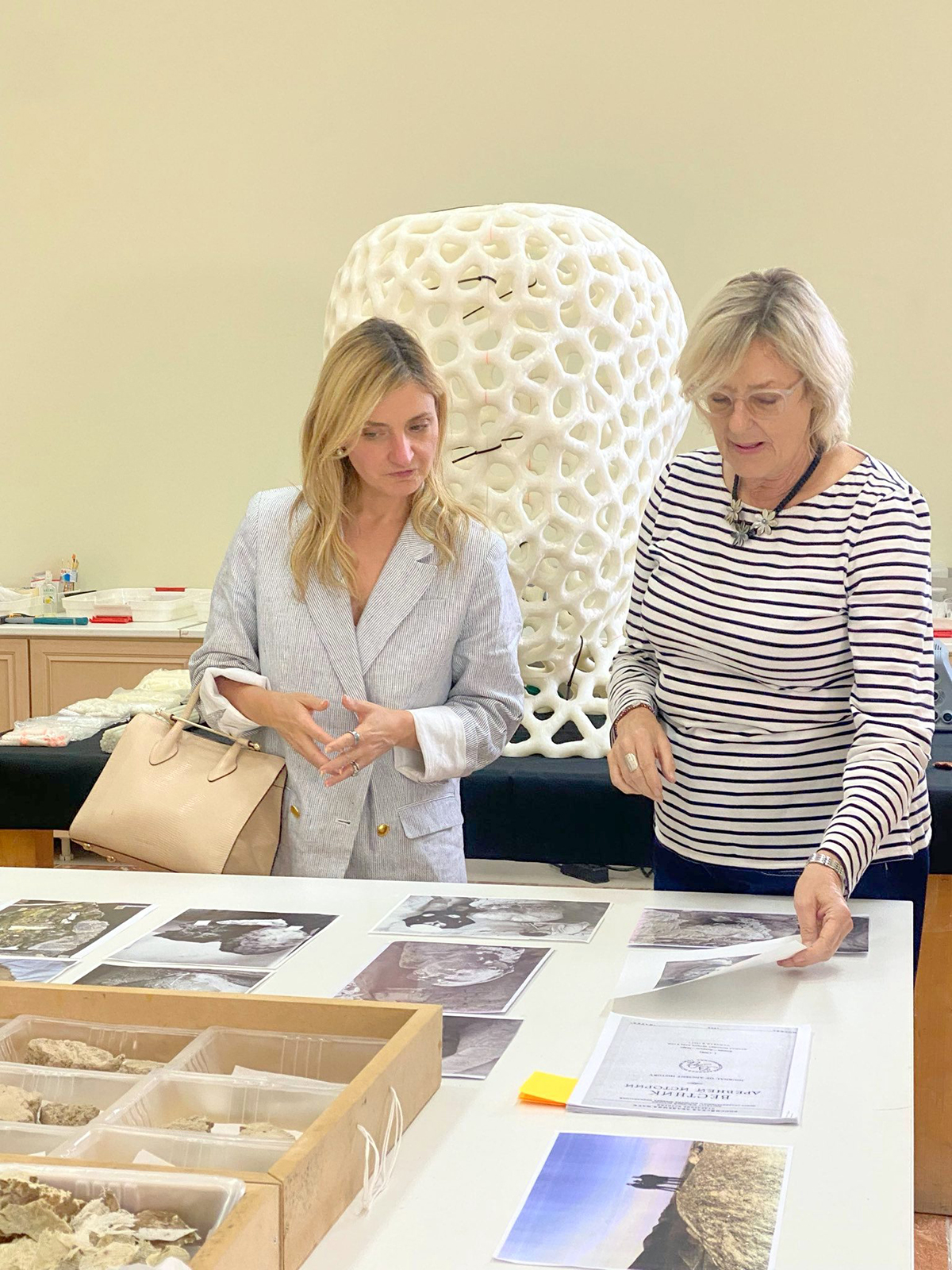
As part of the official visit to Turkmenistan by Sarah Rogers, U.S. Under Secretary of State for Public Diplomacy, the restoration laboratory at the State Museum was visited by a high-level delegation. The delegation included Sarah Rogers’ Special Assistant Vanessa Vidal Castellanos, Special Advisor Joseph Gunnar Sydac, and Elizabeth Rood, Ambassador Extraordinary and Plenipotentiary of the United States to Turkmenistan.
Professor Susanne Gänsicke provided the guests with a detailed overview of the highly complex restoration process, demonstrating the digital replica and presenting research materials. During the meeting, the exceptional historical significance of the artifact was emphasized.
The sculpture fragment, discovered in Ancient Merv in 1960 and dating to the 5th century CE, is part of a stupa—a Buddhist architectural and sculptural religious structure erected in a city that, more than fifteen centuries ago, was one of the most important hubs along the Great Silk Road.
Researchers believe that after the destruction of the stupa, Buddhist monks carefully buried the head of the statue in an effort to save it from complete destruction.
On behalf of the entire international team, Susanne Gänsicke expressed deep gratitude to the leadership of both Turkmenistan and the United States for their comprehensive support of this important scientific mission. She also thanked the leadership of the U.S. Department of State for its personal interest in the project.
The current visit of the American restoration specialists will continue until June 20. The joint work of scholars from the two countries is not only bringing a priceless archaeological monument back to life but also serves as a vivid example of successful and long-term cultural and humanitarian dialogue between Turkmenistan and the United States.