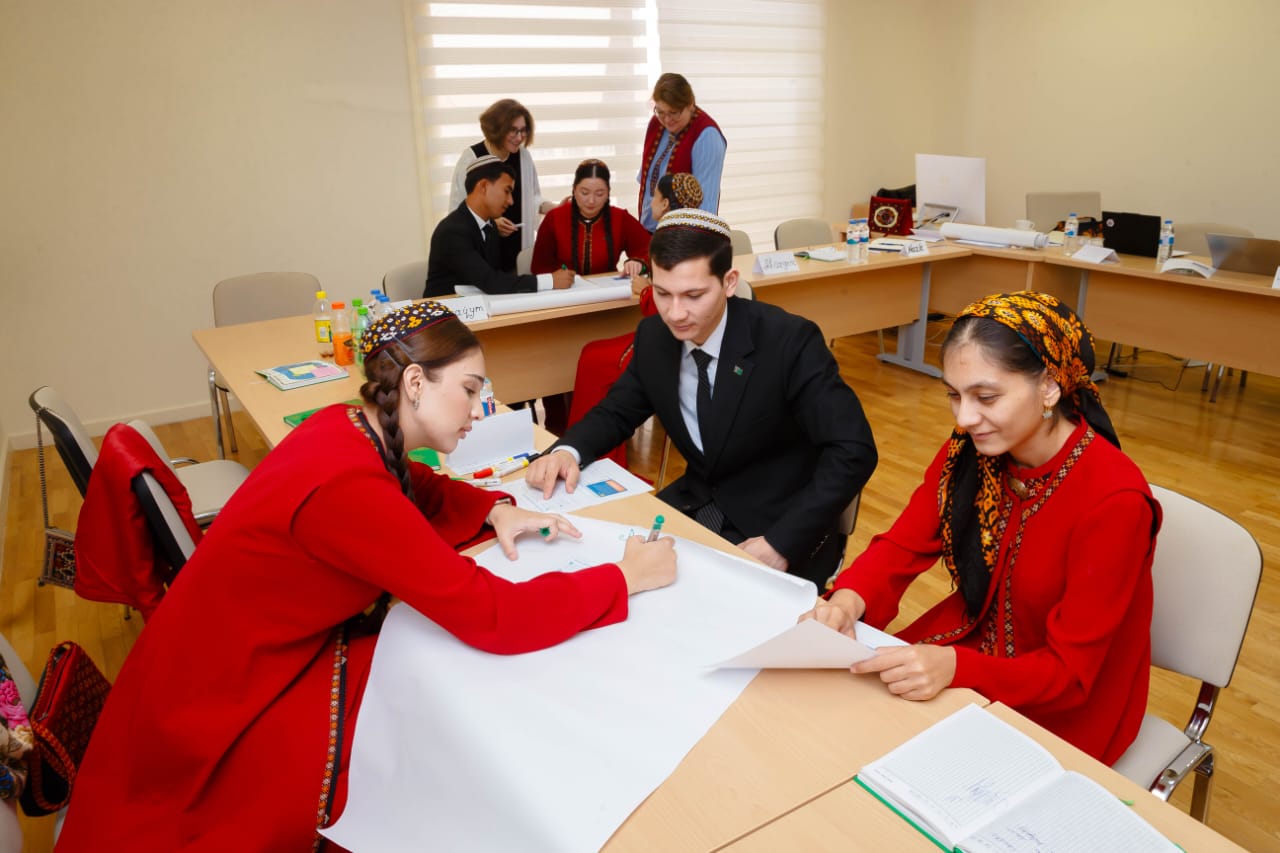



A two-day international seminar began today in the Turkmen capital at the administrative building of the country’s Ministry of Communications. A delegation led by Konstantin Savin, Technology Lead at GSMA Eurasia and an expert of the International Telecommunication Union (ITU), arrived in Turkmenistan to participate in the event.
The opening day of the seminar featured a comprehensive program. As noted, the national economies of the CIS countries are undergoing a broad digital transformation driven by the introduction of new communication technologies, which are ushering in a new era for the telecommunications sector by making it faster and more flexible. In this context, the seminar serves as a platform for exchanging views on the key areas of modern technology implementation, as well as on measures to accelerate the work of government institutions and regulatory authorities in introducing new services for the benefit of the country's population.
The seminar aims to familiarize participants with various technologies and concepts for the development of mobile and direct communication systems; to examine the key differences between the current and previous stages of communication technology development, including mobile, satellite, and direct communication methods; to explore the automation of communication systems through artificial intelligence; and to review international examples of implementing new technologies. Particular attention is being paid to understanding how governments and regulatory bodies can facilitate the accelerated adoption of new technologies and services nationwide.
On the first day, presentations were delivered on "General Perspectives on the Development of the Digital Economy and the Impact of Telecommunications." Participants also learned about the programs and initiatives of the Ministry of Communications of Turkmenistan in the telecommunications sector, while engaging in an in-depth discussion of global trends in information and communication technologies and the outlook for the Eurasian mobile economy through 2026.
In addition, presentations focused on wireless terrestrial access systems. Participants exchanged views on the current stage of mobile communication development, international experience in deploying Fixed Wireless Access (FWA) technologies based on mobile networks, and the implementation of next-generation wireless systems. Discussions also covered the development trends of LPWAN networks operating in both licensed and unlicensed frequency bands, the future of satellite communication systems in low-Earth, medium-Earth, and geostationary orbits, the potential for direct satellite-to-mobile data transmission, and the key challenges facing these technologies.
The seminar also addressed wired communication networks, including advances in fiber-optic communication technologies, as well as the current state and future prospects for modernizing optical networking equipment.
At the conclusion of the first day, participants held a question-and-answer session on the topics discussed and summarized the day's proceedings.
The international seminar continues.